


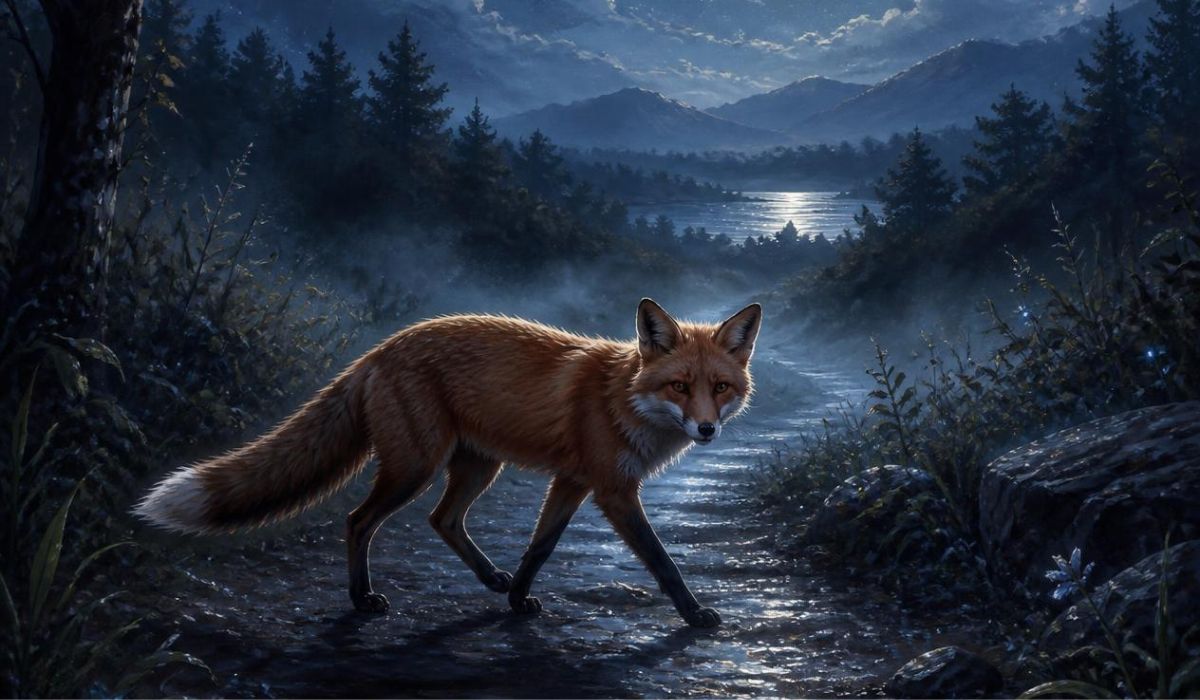
Foxes don’t wander into your field of vision by accident — at least, that’s what nearly every indigenous tradition on earth has agreed on for thousands of years. When a fox crosses your path, the encounter carries what shamanic traditions call a “stop and read” moment: the animal world pressing pause on your ordinary thinking to deliver a specific message. The fox spiritual meaning crossing path is one of the most nuanced in all of animal symbolism, and most interpretations only scratch the surface of what it’s actually telling you.
The deeper reason this encounter is hard to interpret is that the fox belongs to a rare category of spiritual messenger: the trickster archetype. Trickster figures don’t deliver simple, comforting signs. They arrive at the exact moment you’re operating on autopilot — running on assumption, reacting emotionally, or trusting the wrong person — and they interrupt that pattern deliberately. That’s what makes this sighting different from seeing a deer cross your path, which carries a message of gentleness and grace. The fox is sharper than that.
A fox crossing your path spiritually signals one of four specific situations: a problem that requires cleverness rather than force, someone in your immediate life who is not what they appear to be, an invitation to observe before you act, or a warning to lead with your intelligence rather than your emotions. Which of these applies to you depends heavily on the *timing* and *direction* of the crossing — details that most sources gloss over but that traditional animal medicine reads as the actual message.
The numbers you were born with are arguing with each other.
Discover which one is winning — and what your seven core numbers reveal about who you really are beneath everything else.
Get Your Free ReadingThe Fox Is Not the Coyote — and That Distinction Changes Everything
Both the fox and the coyote are trickster figures in Native American spiritual traditions, but they teach through entirely different methods. The coyote teaches through disruption — it blows things up so you’re forced to rebuild. The fox teaches through cunning observation and strategy. Where the coyote creates chaos to deliver its lesson, the fox moves in silence. It watches. It waits. Then it moves with precision.
In Jungian psychology, the trickster archetype represents the part of the psyche that breaks down rigid thinking and false certainty. Carl Jung described the trickster as a figure who appears at the threshold between what you know and what you need to learn. The fox, across Japanese Shinto (where the kitsune is a divine messenger of Inari, god of wisdom and harvest), West African Dogon mythology, and countless European folklore traditions, consistently fills this role. It is never simply lucky or unlucky. It is always a signal that your current strategy is incomplete.
This cross-cultural consistency matters. When a symbol appears with the same core meaning across traditions that never had contact with each other, that’s not coincidence — it’s pattern recognition at a collective level. The fox is asking you to apply that same pattern recognition to your own situation right now.
Why the Timing of Your Fox Sighting Is the Real Message
Here is the screenshot moment: the spiritual meaning of a fox crossing your path shifts significantly based on *when* and *how* the crossing happens. This is the part of fox symbolism that competitors almost always reduce to a single bullet point. Traditional animal medicine treats these variables as separate messages layered on top of the core meaning — like modifiers on a sentence.
Morning sighting: A fox seen in the morning hours is connected to new strategies and fresh decisions. You’re being asked to approach an upcoming situation — one you haven’t fully resolved — with a completely different angle than you’ve been using. Morning light in spiritual traditions represents clarity and beginning. The fox here is a planner’s signal.
Night or dusk sighting: Foxes are crepuscular, most active at twilight — which is itself a liminal time, neither day nor night. A fox crossing your path at dusk or night carries a stronger warning quality. Someone or something in your life is operating in shadow. This sighting asks you to pay attention to what is being concealed, not what is being shown. Trust your instincts over the narrative you’ve been given.
Moving toward you: A fox walking in your direction before crossing brings an incoming message — something is coming that will require your full strategic awareness. Prepare rather than react. Moving away from you: The fox retreating as it crosses is a release signal. Something you’ve been gripping — a plan, a relationship dynamic, an old way of handling conflict — needs to be let go of. The fox is showing you its back on purpose.
Crossing left to right: In many Western esoteric traditions, left represents the intuitive, receptive, internal world, while right represents outward action and the material world. A fox moving from your left to your right is signaling a shift from inner knowing to outer expression — you already have the answer. Act on it. Crossing right to left reverses that: stop taking external action and go inward. You’re missing something that can only be found through reflection, not more doing.
When the Fox Is Warning You About Someone Else
One of the most overlooked meanings in fox symbolism is its role as a social mirror. Most articles focus on what the fox is asking *you* to do. But in Japanese kitsune lore and in Celtic tradition, the fox appearing on your path was specifically understood as a signal about another person — someone whose true nature or true motives you haven’t fully seen yet. This isn’t about paranoia. It’s about discernment.
Think about who has recently entered your life, or who is currently asking something of you. Research in social psychology shows that humans tend to over-rely on verbal communication and under-weight behavioral patterns when assessing trust — we believe what people say more than what they consistently do. The fox sighting, in this context, is an invitation to reverse that ratio. Watch the patterns. Read the behavior over time. This is exactly how attachment theory describes the formation of secure versus insecure relational bonds — through repeated, observed actions, not stated intentions.
Unlike a lizard crossing your path, which often signals the need to shed your own outdated patterns, the fox encounter specifically redirects your attention outward — to the environment around you and the people within it. That’s a meaningful distinction worth sitting with.
So What Is the Fox Actually Asking You to Do?
The fox is not asking you to become sly or manipulative. That’s the most common misreading of this symbolism. It’s asking you to stop using brute force — emotional outbursts, constant pushing, or waiting for the situation to fix itself — and start using strategic patience. Observe first. The fox spends far more time watching than moving. That ratio is the lesson.
Practically speaking, this might mean delaying a conversation you’ve been ready to have until you’ve gathered more information. It might mean stepping back from a decision that feels urgent but is actually just emotionally charged. It might mean noticing what’s happening at the edges of a situation — the details that don’t quite add up — rather than focusing only on the center of it. Just as a white cat crossing your path asks you to trust what you sense beyond the visible, the fox asks you to trust what your intelligence already suspects but your emotions haven’t yet accepted.
The fox is one of few animals that thrives equally in wilderness and urban environments. Biologically, this adaptability comes from its willingness to learn new systems rather than repeat old behaviors that no longer work. That’s not a metaphor — it’s the actual survival mechanism. Spiritually, the fox crossing your path is asking you to apply that same mechanism to whatever situation is pressing on you right now.
Frequently Asked Questions
What does it mean when a fox crosses your path from left to right?
In Western esoteric tradition, left to right movement represents a shift from inner knowing into outward action. A fox crossing in this direction is telling you that you already have the insight or answer you’ve been seeking — the message is to stop deliberating and move. It’s a green-light signal, not a warning.
Is seeing a fox crossing your path good luck or bad luck?
Neither — and that framing misses the point entirely. The fox doesn’t deliver fortune; it delivers information. Across Japanese Shinto, Celtic, and Native American traditions, the fox is a messenger of strategic awareness, not a luck omen. Whether the message feels good or uncomfortable depends entirely on what it’s pointing to in your current situation.
What does a fox crossing your path at night mean spiritually?
A nighttime or dusk fox sighting carries a stronger warning quality than a daytime encounter. Because foxes are naturally crepuscular — most active at twilight — seeing one cross your path at night amplifies the message about hidden information. Something in your current situation is operating in shadow and needs your closer attention before you make your next move.
How is the fox different from the coyote as a spiritual messenger?
Both are trickster figures in Native American traditions, but they teach differently. The coyote’s spiritual message arrives through disruption and chaos — it breaks things down so you’re forced to rebuild. The fox works through quiet observation and precision strategy. If the coyote blows up your plan, the fox reveals why your plan had a flaw you hadn’t noticed. One is a demolition crew; the other is a forensic analyst.
A fox crossing your path isn’t random, and it isn’t just about being clever. It’s a precision signal arriving at a moment when you’re about to rely on the wrong tool — force instead of strategy, emotion instead of intelligence, noise instead of watching. Whatever situation is active in your life right now, the fox is asking you to slow down, observe more, and trust what your mind already suspects before your emotions catch up. That’s the one message across every tradition that never changes.


