


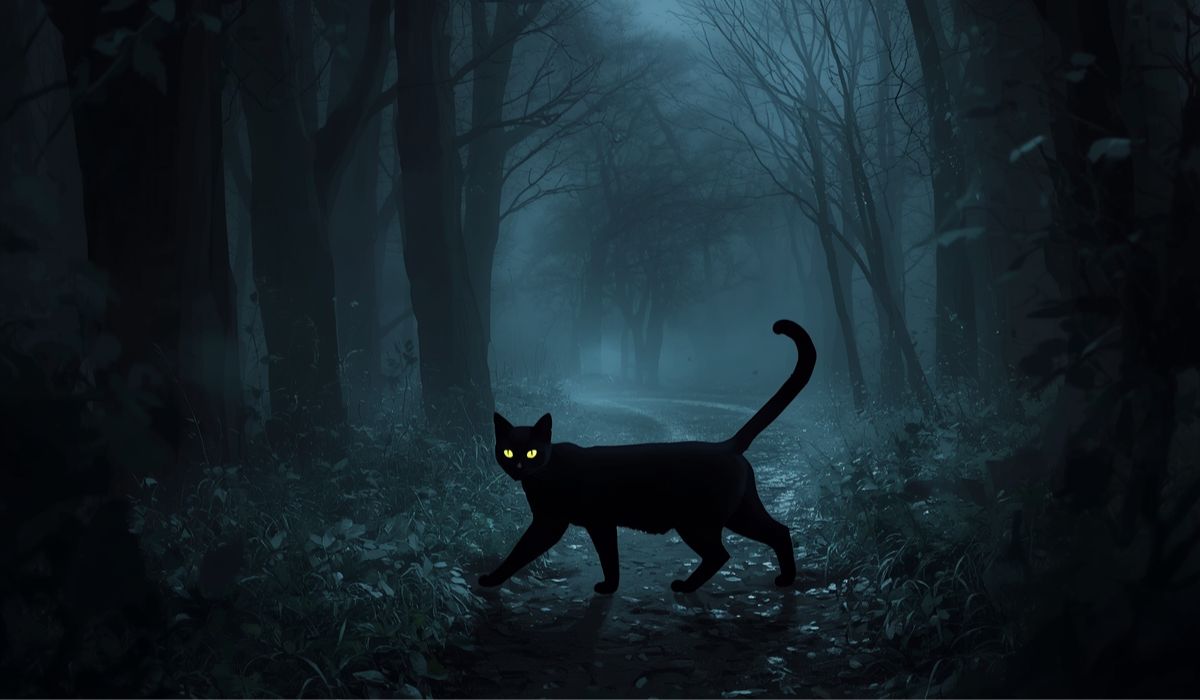
Bad luck is a borrowed belief. The fear that shoots through your chest when a black cat crosses your path — that startle, that split-second urge to recalculate your route — doesn’t belong to you. It was handed down through centuries of mistranslated symbolism, and it’s been quietly shaping how you relate to one of the most spiritually significant animal encounters you can have.
The black cat spiritual meaning most articles give you is a cultural checklist: good luck in Japan, bad luck in medieval Europe, revered in Egypt. That’s all true. But it barely scratches the surface of what’s actually being communicated when one of these animals crosses your path. The deeper message isn’t about luck at all.
A black cat crossing your path is a spiritual prompt toward protection, boundary awareness, intuition activation, and shadow integration. Across dozens of traditions spanning thousands of years, this animal consistently appears as a guardian — not a threat. The “bad luck” narrative is the outlier, not the rule, and it was institutionalized in 1233 CE when Pope Gregory IX’s papal decree “Vox in Rama” formally linked black cats to devil worship in European Christian doctrine. Before that document, the symbolism was almost universally positive.
The numbers you were born with are arguing with each other.
Discover which one is winning — and what your seven core numbers reveal about who you really are beneath everything else.
Get Your Free ReadingWhy the Black Cat Spiritual Meaning Was Never About Luck
Ancient Egyptians didn’t think in terms of luck when they saw a black cat — they thought in terms of divine protection. The goddess Bastet, depicted as a cat, was associated with fertility, the home, and guarding against evil spirits. Black cats in particular were considered sacred, believed to carry the protective force of the goddess herself. The contrast with white cat symbolism is striking: where the white cat carries messages of purity and new cycles, the black cat carries the energy of active protection and unseen-world awareness.
In Celtic tradition, a black cat arriving at your home was a sign of prosperity entering your life. Scottish folklore held that a strange black cat appearing on your doorstep signaled incoming abundance. In Japan, black cats are associated with good fortune and love — single women who encountered one were thought to attract more suitors. These weren’t fringe beliefs. They were the dominant understanding of this animal for most of human history.
The fear-based interpretation is geographically and historically narrow. It traces almost entirely to a specific 200-year window in medieval Western Europe when the Church systematically dismantled pre-Christian animal reverence. Understanding that origin doesn’t dismiss your reaction to seeing one — but it does free you from treating that reaction as spiritual truth.
The Angle Nobody Talks About: Shadow Integration
Here’s what the cultural round-up articles miss entirely: the black cat may be the animal kingdom’s most precise symbol of what Carl Jung called the Shadow — the parts of yourself you’ve been taught to suppress, mistrust, or hide. Jung identified the Shadow as the unconscious repository of everything you’ve deemed unacceptable, and he was clear that refusing to acknowledge it doesn’t make it disappear. It makes it run your life from behind the scenes.
The black cat is dark, quiet, moves at night, sees in the dark, and has been systematically misunderstood and feared for centuries. Sound familiar? The qualities you’ve been told make this animal dangerous are the exact qualities that make it powerful. Your intuition works the same way — it operates below conscious awareness, it makes moves you don’t always understand in the moment, and most people spend years learning to distrust it. When a black cat crosses your path, one reading is that your own unloved instincts are asking for acknowledgment.
This is the screenshot moment: the black cat doesn’t bring bad luck. It reveals where you’ve already been running on fear — and calling it something outside yourself. Just as a coyote crossing your path signals trickster energy and the need to examine self-deception, the black cat signals the places where you’ve been deceived into fearing your own perception.
What Your Intuition Is Actually Trying to Tell You
Cats, across species and across spiritual traditions, are consistently associated with intuitive perception. They sense things before humans do — shifts in atmosphere, emotional tension, energetic change. The polyvagal theory in neuroscience, developed by Dr. Stephen Porges, maps how the nervous system reads environmental safety before the conscious mind catches up. Cats operate almost entirely from that pre-cognitive layer. When one crosses your path, it may be signaling that your own nervous system is already registering something your rational mind hasn’t processed yet.
Ask yourself what you were thinking about in the thirty seconds before the encounter. Were you second-guessing a decision? Rationalizing a situation that feels off? Preparing to cross into a space — physical, relational, professional — where something hasn’t been sitting right? The black cat’s appearance, in many traditions, is a call to pause and trust that pre-verbal signal rather than override it. Just as a mouse crossing your path often signals the need to notice small overlooked details, the black cat points specifically to the larger knowing you’ve been dismissing.
This is why so many spiritual frameworks connect black cats to boundary-setting. Not as a superstition about external events, but as a prompt: you already know what you need to say no to. The cat is just making sure you heard yourself.
The Feminine Power Thread Across Traditions
Across Egyptian, Celtic, Norse, and Japanese traditions, the black cat is consistently tied to feminine power — not femininity as softness, but as sovereign discernment. Bastet was a warrior goddess before she became associated with domesticity. The Norse goddess Freyja, associated with love, war, and magic, rode a chariot pulled by two large black cats. The Celtic tradition connected cats to the otherworld and to women with second sight. The thread isn’t coincidence — it’s a cross-cultural recognition that this animal carries the energy of perception that operates outside daylight logic.
This feminine power framework doesn’t apply to any particular gender. It applies to the mode of knowing that prioritizes felt sense, pattern recognition, and unseen-world awareness over linear analysis. If you’ve been suppressing that mode in yourself — deferring to what looks right on paper instead of what feels true in your body — the black cat crossing your path may be a direct signal to rebalance. Similar to the butterfly landing on you, the encounter is hard to explain rationally, which is exactly the point.
When the Black Cat Appears Repeatedly
A single encounter is a nudge. Repeated encounters with black cats — crossing your path in different locations, appearing at thresholds like doorways and road intersections, making eye contact before moving on — carry more weight in most traditions. In many animist frameworks, an animal that recurs is functioning as a totem or messenger, not a random event. The recurring black cat is asking you to look at the same thing from multiple angles until you actually address it.
Unlike a deer crossing your path, which tends to carry gentle, receptive energy, the black cat is more insistent. It doesn’t wait for you to be ready. It moves across your field of vision at its own timing, without apology — which is itself part of the message. You’re being shown what it looks like to trust your own movement without seeking permission or managing other people’s reactions to it.
Frequently Asked Questions
Is a black cat crossing your path good or bad luck?
In the majority of world traditions — Egyptian, Japanese, Celtic, Scottish, and Norse — a black cat crossing your path is a positive sign associated with protection, good fortune, and intuitive guidance. The “bad luck” interpretation is primarily rooted in medieval Western European Christian doctrine, specifically after the 1233 CE papal decree “Vox in Rama,” which formally linked cats to non-Christian spiritual practice. Statistically, the good-luck interpretation is the global majority view.
What does it mean spiritually when a black cat stares at you?
Direct eye contact from a black cat is widely interpreted across spiritual traditions as a specific prompt — not a general one. Many traditions hold that the cat is functioning as a mirror in that moment, drawing your attention to something you’ve been avoiding seeing about a situation. It’s less a sign of incoming events and more an invitation to look honestly at something you’re currently rationalizing or bypassing.
What does a black cat crossing your path mean for relationships?
In the context of relationships — romantic, family, or with yourself — the black cat crossing your path often signals a need to re-examine where your boundaries have gone unspoken. The protective symbolism of this animal in nearly every tradition points to self-guardianship: the black cat may be appearing precisely when you’ve been giving access to someone or something that your gut has already flagged as unsafe or draining.
Does the direction the black cat crosses matter spiritually?
Some traditions — particularly German folk belief — assign meaning to direction: left to right is a favorable omen, right to left less so. However, this directional reading is culturally specific and not universal. Most broader spiritual frameworks focus less on direction and more on the quality of the encounter — whether eye contact was made, whether the cat paused, and what you were actively thinking or feeling in the moments before the animal appeared.
The next time a black cat cuts across your path and that old conditioned fear flickers through your body, you have a choice: hand your interpretation over to a 13th-century document written to control pre-Christian populations, or reclaim the one the Egyptians, the Celts, the Scots, the Japanese, and your own gut have always known — that this animal is a protector, and it just walked through your life on purpose. Explore more animal crossing meanings to keep building your understanding of what the natural world may be communicating directly to you.


