


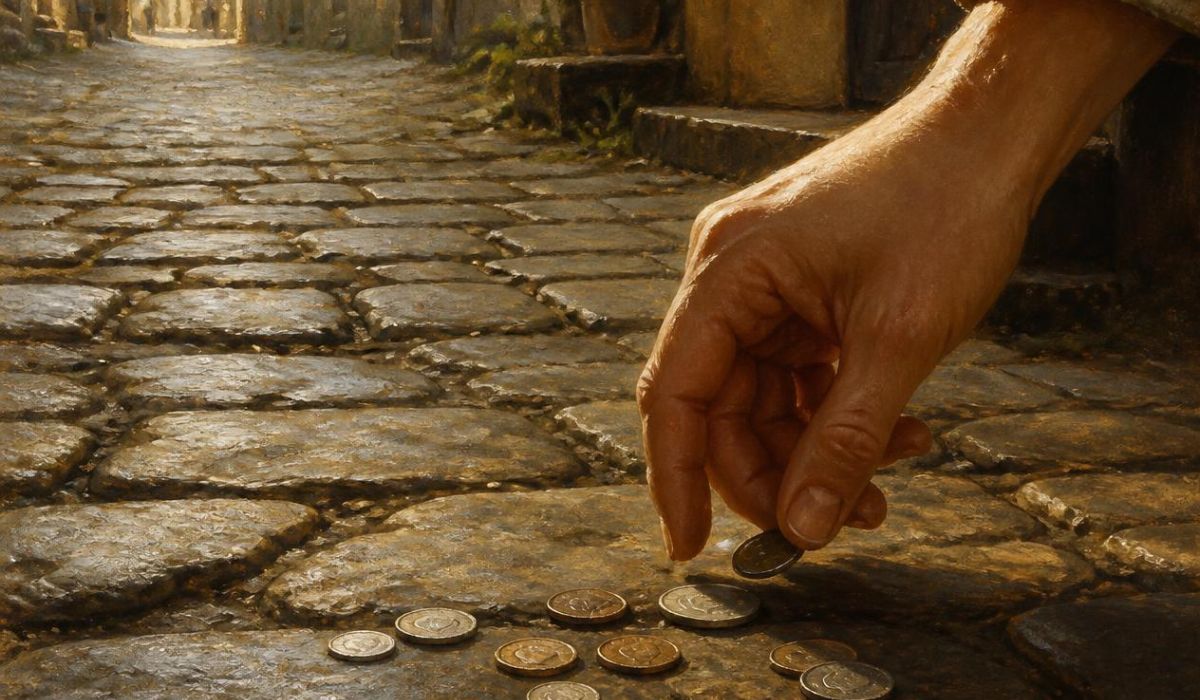
Pennies don’t fall out of thin air — and yet there it is, sitting face-up on the floor of a closed stairwell you’ve walked a hundred times. Finding coins spiritual meaning is one of the most widely reported spiritual signs across cultures, and the experience is too consistent to be brushed off: the right coin, in the wrong place, at exactly the moment you needed to feel less alone. Research by grief scholars Klass, Silverman, and Nickman — who developed the Continuing Bonds Theory in 1996 — found that maintaining a felt sense of connection with someone who has died is not pathological, but natural and healing. Coins may be one of the most tangible ways that connection expresses itself.
Here’s what makes this harder to dismiss than a coincidence: your rational mind is trained to ignore what doesn’t fit. You walk past hundreds of sidewalk cracks daily and register none of them. So when a coin stops you cold — when you actually notice it, pick it up, and feel something shift — that interruption itself is the message. Carl Jung called this synchronicity: a meaningful coincidence that carries more psychological weight than probability alone can explain. The coin didn’t appear from nowhere. But the moment it arrested your attention did not happen randomly either.
So what does finding a coin on the ground actually mean spiritually? A found coin is widely understood as a deliberate sign from the spiritual realm — a deceased loved one, a guardian angel, or the universe itself — confirming that you are seen, supported, and moving in the right direction. The type of coin, its orientation, and the location where you find it each carry a distinct layer of meaning.
The numbers you were born with are arguing with each other.
Discover which one is winning — and what your seven core numbers reveal about who you really are beneath everything else.
Get Your Free ReadingWhy Pennies Carry the Weight of the People You’ve Lost
Ask anyone who has lost someone close, and a startling number of them will mention finding pennies. The phrase “pennies from heaven” predates the internet by generations — it’s embedded in American folk tradition precisely because the experience keeps repeating across families and decades. A penny appearing on the kitchen counter after a parent’s funeral. A penny face-up in the grass on what would have been their birthday. These aren’t small moments. They’re the kind that surface in memory the way certain moments do — uninvited, piercing, and strangely comforting.
Spiritually, the penny carries the energy of the number 1 — numerologically linked to new beginnings, wholeness, and the continuation of something beyond an ending. Many traditions hold that a deceased loved one uses a penny as a calling card: a way of saying I’m still here, and I haven’t forgotten you. The copper itself matters in some folk traditions — copper has been used in ritual and burial rites across ancient Egypt and Celtic cultures as a metal that conducts energy between realms.
If you keep finding pennies after a loss, the invitation isn’t to prove whether it’s real. The invitation is to let it comfort you — because according to Continuing Bonds Theory, staying connected to someone you’ve lost is not grief going wrong. It’s grief doing exactly what it’s supposed to do.
Dimes Are Different — And Most People Don’t Know Why
Dimes generate a disproportionate number of reported spiritual encounters relative to their size and value, which tells you something. A dime found in an inexplicable location — inside a sealed box, in the middle of a freshly made bed, on a shower floor in a room no one entered — carries a specific quality that feels angelic rather than ancestral. Where pennies tend to feel like a loved one’s hand on your shoulder, dimes tend to feel like a broader confirmation: you are on the right track, even when your own confidence has run out.
Numerologically, the dime’s connection to the number 10 — which reduces to 1 — gives it a dual message: the completion of one cycle and the clean start of another. Just as certain memories loop back at the precise moment they’re needed, dimes tend to appear when you’re standing at a decision point and doubting your own instincts. The spiritual read is straightforward: trust what you already know. The angel isn’t pushing you — it’s confirming what you’ve already sensed.
Quarters carry a different register again. In numerology, 25 cents connects to the number 7 — linked to inner knowing, spiritual depth, and the kind of wisdom that comes from having gone through something hard. Finding a quarter often signals that a significant chapter is closing and something larger is being prepared for you.
The Location Changes Everything
This is the angle almost no one talks about — and it’s the one that will make you pay attention differently every time you find a coin from now on. There’s a meaningful spiritual distinction between finding a coin in an ordinary location and finding one in a place it simply should not be. A coin on a sidewalk is a sign. A coin on your pillow when no one has been in the room is a louder, more urgent version of the same message.
Think of it as a graduated signal system. Ordinary placement — parking lot, curb, store floor — is a gentle confirmation: you’re noticed, you’re loved, keep going. Unusual placement — inside a locked car, on the altar you set up last week, in the exact spot where someone used to sit — is the spiritual equivalent of a direct call rather than a text. The more improbable the location, the more specific and pressing the message tends to be. Pay attention to what you were thinking about in the thirty seconds before you found it.
Your emotional state at the moment of discovery matters as much as the coin itself. Grief researchers have noted that people in active emotional processing are more attuned to environmental pattern — not because they’re imagining things, but because attention is sharpened by feeling. That sensitivity isn’t weakness. It’s the mechanism by which signs get received.
Heads Up or Tails Up — The Orientation Is Part of the Message
Folk tradition has long held that a heads-up coin is lucky and a tails-up coin should be left alone — or flipped over for the next person to receive the luck. Spiritually, the distinction runs deeper than superstition. A coin found face-up (heads) is generally interpreted as a full, clear yes: affirmation, open energy, forward momentum. The image of the leader on the face of the coin — in most American traditions, a president — symbolizes authority and confidence. This is the universe making eye contact with you.
A tails-up coin is not a bad sign — it’s a redirectional one. Some spiritual traditions interpret tails-up as a prompt to pause, review, or reconsider a decision before moving forward. It’s not a stop sign; it’s a yellow light. If you’ve been pushing hard in one direction and you find a tails-up dime, the message may be to slow down enough to check what you’re actually building toward. The coin still reached you. The love behind it is still real. The direction of the advice just shifted.
The Screenshot Moment: What to Do When You Find One
Picture this: you’re in the middle of a hard week. You’ve been questioning a decision, missing someone, or running low on the kind of faith that normally comes easily to you. You look down — and there’s a dime, heads up, on the carpet of a room you just vacumed. Nobody else has been in there. There’s no reasonable explanation for how it got there. And for just a moment, the noise in your head goes completely quiet.
That moment of silence is the actual message. Not the coin — the silence it creates. Pick it up. Hold it. Ask yourself: what was I just thinking about? What decision is sitting open right now? What name just came to mind? The coin’s job is to get you to stop and listen, because whatever answer rises in that stillness is the one that was already inside you, waiting for a gap in the noise to be heard.
Keep the coin somewhere intentional — a windowsill, a wallet, a small dish on your nightstand. Not because the metal itself holds power, but because every time you see it again, it will pull you back to that moment of stillness. That repetition is its own kind of spiritual practice.
Frequently Asked Questions
What does it mean if I keep finding coins repeatedly over several days?
Repeated coin finds over a short period are widely interpreted as an escalating message — the spiritual equivalent of someone knocking louder because you didn’t answer the first time. Pay attention to what is unresolved in your life right now: a decision you’re avoiding, a grief you haven’t fully acknowledged, or a direction you’re second-guessing. The repetition is the signal that the message is time-sensitive, not just comforting.
Is there a spiritual meaning to finding coins after someone dies?
Yes — and it’s one of the most commonly reported forms of after-death communication. Finding pennies or dimes following a loved one’s death is understood across multiple traditions as that person’s spirit reaching through the physical world to say they are at peace and still present with you. The Continuing Bonds framework in grief psychology validates that maintaining this felt sense of connection is healthy, not denial.
Does the type of coin — penny, dime, quarter — change the spiritual message?
Yes, meaningfully so. Pennies are most associated with messages from deceased loved ones and carry the numerological energy of new beginnings (number 1). Dimes carry angelic energy and signal confirmation that you’re on the right path — they’re the most commonly reported coin in unexplained or impossible locations. Quarters connect to the number 7 in numerology, suggesting deep spiritual growth and the close of a significant life chapter.
Should I pick up a tails-up coin or leave it?
Pick it up — but receive the message it carries. A tails-up coin isn’t bad luck; it’s a directional nudge to pause and reconsider before moving forward with something. Some people flip a tails-up coin to heads before leaving it, sending the open energy on to whoever finds it next. Either response is valid. The more important question is: what were you thinking about when you found it?
A coin is worth almost nothing in your pocket. But in the right moment, in the wrong place, it carries the full weight of every question you’ve been afraid to ask out loud — and a quiet answer you already knew.


