


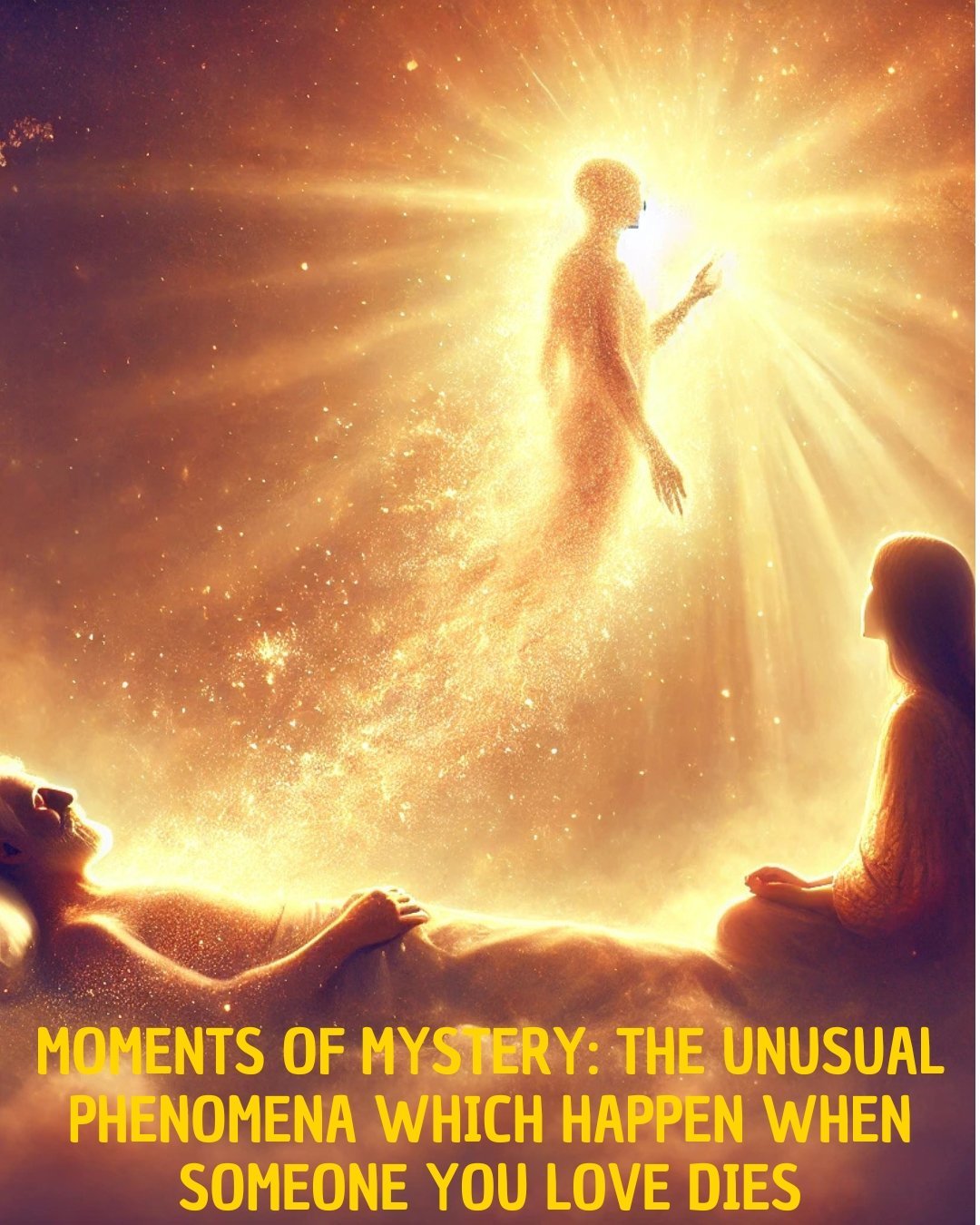
Being with a loved one during their final days or moments is an emotionally charged experience. It is also a time when unusual things happen that cannot be explained in a normal manner.
Some people describe hearing whispery voices in an empty room, smelling a familiar scent in the air when no one else is around, or noticing certain animals appearing at precisely meaningful times.
Though such phenomena might seem random to others, they are filled with profound meaning for those who are grieving.
The numbers you were born with are arguing with each other.
Discover which one is winning — and what your seven core numbers reveal about who you really are beneath everything else.
Get Your Free Reading
Most describe inexplicable coincidences or sensing an unseen presence shortly before or shortly after a loved one has died. Science can’t easily provide an explanation for such phenomena, but they may provide comfort, intrigue, or even a sense of closure.
In most cultures, accounts of such unusual events are commonplace when death approaches. But for those who have never experienced them, confronting the inexplicable is disconcerting.
Some attribute it to the mind’s attempt to deal with bereavement. Others believe it reflects deeper human consciousness that science today can’t fully grasp. Whatever the explanation, such occurrences are far from unusual.
Learning about their potential origins and significance can teach us more about the human condition, particularly at life’s most vulnerable moments.
Perceiving the Mystery in Death’s Proximity

As a person nears the end of life, relatives and friends cluster around the bedside. Emotions are heightened, and the divide between the mundane and the transcendent is sometimes breached.
People report watching their loved ones converse with invisible visitors or describing visions of heat and light. Doors open and shut with no one on the other side, clocks stop at the time of death, or a favorite hymn appears on the radio.
Anecdotal though these accounts are, they appear in so many individual reports that it is difficult to write them off as mere coincidence.
These accounts occur in diverse cultures around the globe. They’re considered in some locations as sacred harbingers of a meeting between the physical and spiritual realms.
Hospice workers sometimes remark that they’re used to these things and no longer find them noteworthy. The specifics of each report differ, but all describe a pattern of mysterious events as life fades.
The occurrence of such moments does not attend every death, but the similarities point to something beyond coincidence.
In these final hours, people do tend to experience things more intensely. Stress, grief, and raw emotion can distort the perception of the environment. This increased sensitivity does not necessarily translate into imagined events.
In fact, most report never being more convinced of what they see or feel. Although their accounts may disagree with mainstream explanations, they are reassuring—especially if they indicate a peaceful and gentle presence guiding the transition from life to death.
Cultural Interpretations and Religious Beliefs
Our religious or cultural beliefs strongly condition our understanding of inexplicable events. Most faiths instruct that the spirit of the human being endures physical death.
Within these beliefs, it is not unusual for family members to notice signs that the dying person is being greeted by angels, ancestors, or friendly spirits.
On every continent—from Asia to Africa, Europe to the Americas—myths and sacred texts speak of a reality beyond the usual that communicates with us at the time of death.
Some Native American cultures tell of animals serving as messengers at pivotal life moments. If a specific bird repeatedly visits a window during a person’s dying, for instance, it will be seen as a guardian spirit.
In Buddhism, death in some traditions is viewed as a transition and not a finale, and strange occurrences can be visitations from other realms or the reverberations of karma.
In Christianity, accounts of loved ones returning in dreams or at the bedside blend with notions of heaven and angels.
All of these viewpoints share an assumption that consciousness can be elsewhere in the body, manifesting itself for an instant in these final moments.
To perceive or feel the presence of someone who has died, or to witness something that transcends the rules of daily existence, is like confirmation rather than chance to most.
Not every witness to these events is of a specific religion, however. Many people without any official religious affiliation still feel a unique aura in the environment when death is near.
The frequency of these reports makes them appear to have their origins in common elements of the human condition, perhaps integrating biology, psychology, and spirituality in ways as yet unknown.
The Influence of Emotional and Psychological States
Expectation and feeling regarding loss can strongly condition what people see. Love, fear, and hope can sensitize individuals to minute details.
A subtle shift in the light, a faint sound, or an unusual coincidence can loom large when one is standing watch by a bed. The mind, trying to make sense of a person’s decline, can connect these dots into meaningful patterns.
Rather than dismissing these as illusions, it’s more helpful to see them as part of how we mourn and create meaning.
The nearness of death also makes many people think very seriously about life and its meaning. Such introspection has the potential to open up mental doors that are closed by routine.
Some call it enhanced intuition; others consider it a kind of existential sensitivity that reads special meaning into what would otherwise be chance events.
It is not unheard of for people to receive phone calls or messages at the exact time of a loved one’s passing, and they might read it as a cosmic message closing the gap in those final moments.
Skeptics would explain these events as the mind’s way of coping with heartbreak, especially in instances of extreme stress. While it is true that stress sometimes results in hallucinations, that still doesn’t fully account for the intensity and impact these events take on the individuals who witness them.
For those in mourning, a mystical or spiritual signal can be quite real and reassuring, and it enables them to move on to life without the deceased.
Scientific Views and Recent Research
Though most researchers are cautious about drawing sweeping conclusions, interest in near-death and end-of-life experiences is growing. Some researchers explain such reports as purely neurological or psychological phenomena.
Others explore whether there might be something beyond the realm of physical explanation. Hospice staff, for example, sometimes report patients becoming unexpectedly alert before death or speaking about seeing deceased friends who “visit” to come and take them.
The science here is newer than in orthodox medical fields, but it’s beginning to suggest that human consciousness might not be solely linked to brain function.
Nobody has any definitive answers, but there have been intriguing instances where patients have correctly described events or objects that they were not able to perceive from their hospital beds. Such findings draw the attention of scientists in psychology, medicine, and even quantum physics.
Just because certain phenomena have been ruled out in the past does not make them worthless. Consciousness and the human mind are still complicated and poorly understood.
End-of-life experiences seem to be one of those mysteries that cannot be explained away with a simplistic explanation. Being open-minded allows for possibilities that we have yet to adequately account for.
Somewhere between blind skepticism and credulous acceptance is a more thoughtful position, one that respects the profound experience of those reporting having felt something extraordinary.
Messages of Comfort and Continuity

Perhaps the most comforting thing about these unusual events is the sense of peace they bring. If, when a loved one is dying, a major sign appears—a scent of their perfume, a sudden bloom of a favorite flower, or an unexplained light in the room, for instance—it has the effect of lessening the pain of loss.
Most people report these events as if the universe is providing assurance that the loved one’s energy continues in some form.
In most religious or spiritual traditions, these occurrences are taken as proof of an afterlife. Even individuals who do not have a particular faith may find these experiences therapeutic.
They suggest there’s more to life than daily routines and physical limitations. The warmth of these experiences may be short-lived, yet it can nevertheless seem like a precious gift in the middle of a challenging transition.
Practically, too, these occasions also allow room for healing conversations within family. People will recount dreams, speak of unusual sightings, or share intense feelings not previously revealed.
By embracing such topics, families can grow closer and help one another in the grieving process. The open environment offers an emotional release that can render it a little less painful to go forward.
Balancing Skepticism and Open-Mindedness
Not all who experience or perceive these unusual phenomena will interpret them as spiritual. Others will seek psychological or environmental explanations, or simply be uncertain.
These different perspectives can exist alongside each other, especially if those involved are individuals who value each other’s experience. Constructive scepticism can prevent conclusions being leapt to each time a floorboard creaks or a light bulb flickers.
Healthy curiosity, by contrast, encourages exploration of these experiences without discounting them summarily. Instead of hastening to label them coincidences or tricks of the mind, people can ask what message might be behind the occurrence.
This balanced view respects both the strong feelings accompanying grief and the notion that our world might be more than we currently understand.
Those who care for the grieving can be compassionate by simply listening when one talks about an unexplainable event. To affirm its significance can make all the difference, even when there is no neat explanation.
Such acceptance allows room for healing to take place, making the inevitable mystery of death something that inspires awe, rather than horror.
Conclusion

Strange events that don’t lend themselves to easy explanation often carry a subtle power when someone we love dies. They never appear in banner headlines, and they don’t come with hard scientific proof, but they have a particular gift for soothing sorrowful hearts and encouraging us to consider life’s larger mysteries.
However they manifest – a twirl of light, a whispered word, or an unexpected final contact – each personal anecdote becomes part of a shared tapestry recounted by those who’ve experienced such things.
The aim isn’t to prove or disprove these events but to recognize how they help us find acceptance of loss. A dramatic, unexpected sign can be a gentle bridge, easing the way from having a person physically present with us to keeping them in memory.
These stories also enable us to speak about mortality, consciousness, and how we are connected through the generations. In making space for acceptance and awe, they lessen the pain of farewell.
While that farewell may still be difficult, a small sign or a gentle reassurance—even one that doesn’t make sense—can bring a reassuring sense of peace at a time when it’s most needed.


